

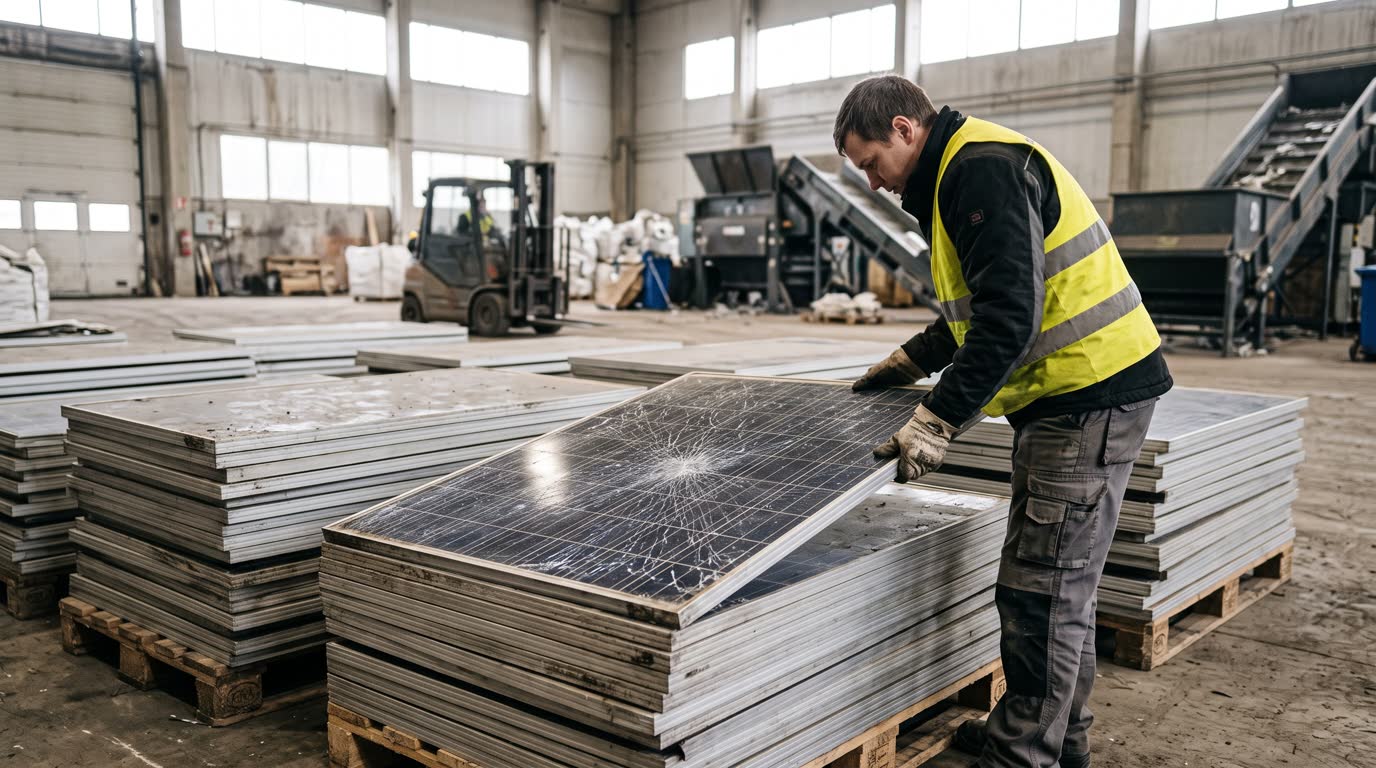
The waste management company Epler & Lorenz has received nearly half a million euros from the European Union Cohesion Fund to set up a solar panel recycling facility in Tartu, ERR reports. Although few old panels are generated in Estonia so far, the question is already on the table of how to recover not only the glass but also the valuable metals from the panels, and who will pay for their recycling decades from now. Solar panel recycling therefore concerns both waste management companies and panel importers, because panels are electrical and electronic equipment subject to producer responsibility.
Panel waste volumes are still small
For more than ten years, solar power has been the fastest-growing area of renewable energy, and according to the Register of Products of Concern, 60,000 tonnes of solar panels were placed on the market in Estonia from 2018 to 2025. Since panels last 25 to 30 years on average, most of them will only become waste decades from now. According to Piret Otsason, head of producer responsibility and hazardous waste at the Ministry of Climate, the waste problem is therefore not yet very large.
“Waste management companies have estimated that in 2027 we may generate a maximum of 1,000 tonnes of solar panels a year,” Otsason noted. She said the quantities are currently very small: last year, for example, the figure was 100 tonnes.
Even so, panels are also replaced before the end of their service life. “One reason is the classic mechanical one: for example, a hailstorm that leaves panels partly unusable, in other words mechanical damage. The other important reason is the chance to get a larger output from the same square metre,” explained Kaur Kuurme, member of the management board of Eesti Elektroonikaromu OÜ.
Glass is simple, metals are complicated
A typical silicon-based solar panel is about 80% glass, with the rest made up of aluminium, polymers, silicon, copper and silver. According to Harri Moora, senior researcher at the Stockholm Environment Institute, crushing and recycling the glass is relatively simple, but the question is how to recover the valuable metals. “There are no good technologies yet, they are very expensive. In my view, there is still not a single simpler technology of that kind in Estonia,” Moora acknowledged.
A step in this direction has now been taken. This year Epler & Lorenz received a Cohesion Fund grant to set up a solar panel recycling facility in Tartu, and according to Janis Lorenz, a member of the company’s management board, the project aims to create the capacity to separate from panels and recycle up to 1,600 tonnes of glass, aluminium, copper and silicon-based fine fractions a year. The International Renewable Energy Agency (IRENA) estimates that up to 80 million tonnes of solar panel waste may accumulate worldwide by 2050. Although most solar panels come from China, the waste generated here has to be treated locally under European Union directives.
Who will pay for solar panel recycling in 30 years?
Solar panels are electrical and electronic equipment subject to producer responsibility. This means that a panel importer or seller must register the quantities placed on the market in the Register of Products of Concern (PROTO) and organise collection and recovery, the costs of which are already included in the product price. Eesti Elektroonikaromu, a producer responsibility organisation, reports on behalf of its members and arranges solar panel recycling for the collected panels. A household panel counts as large electronic equipment and can be handed in free of charge at a waste station; for larger quantities, collection is best arranged in advance. Solar panel recycling in Estonia thus already runs through the same system as other e-waste collection.
In Moora’s view, panels raise a pressing question about producer responsibility, because the fee is paid now while the waste only arises decades later. “The companies operating now pay the fee, but the waste arises in 30 years: those companies may no longer exist at all by then, and neither may that money. The companies active on the market at that time may not be the same ones at all. The question is where the producer responsibility costs should come from in 30 years and who will cover the costs of the recycler, whether that is Epler & Lorenz or someone else,” Moora reflected.
Overall, the Tartu recycling facility is an important step towards treating the solar panel waste generated in Estonia locally and recycling more valuable materials in addition to glass and aluminium. As the larger quantities are still to come, now is the right time to think through both the recycling capacity and how producer responsibility costs will be covered decades from now. For an importer, this means that solar panel recycling is part of their producer responsibility from the moment of sale, not only at the end of the panels’ life.
Read more: Company wants to start recycling solar panels in Tartu, err.ee (in Estonian) and the Eesti Elektroonikaromu articles Solar panels: reuse and circular economy opportunities and Energy storage producer responsibility: five questions an importer must check.
- Battery fires caused 2.66 billion euros of damage to the EU waste sector

- Every battery gets a QR code in 2027, but only large batteries get a battery passport
- Small electronics – 13 surprising items that must not go into mixed municipal waste
- Liisu Miller shows in a video where to take old chargers and cables
- Water-damaged devices: what to do after a flood?
- A household danger that can start fires and fits in the palm of your hand