

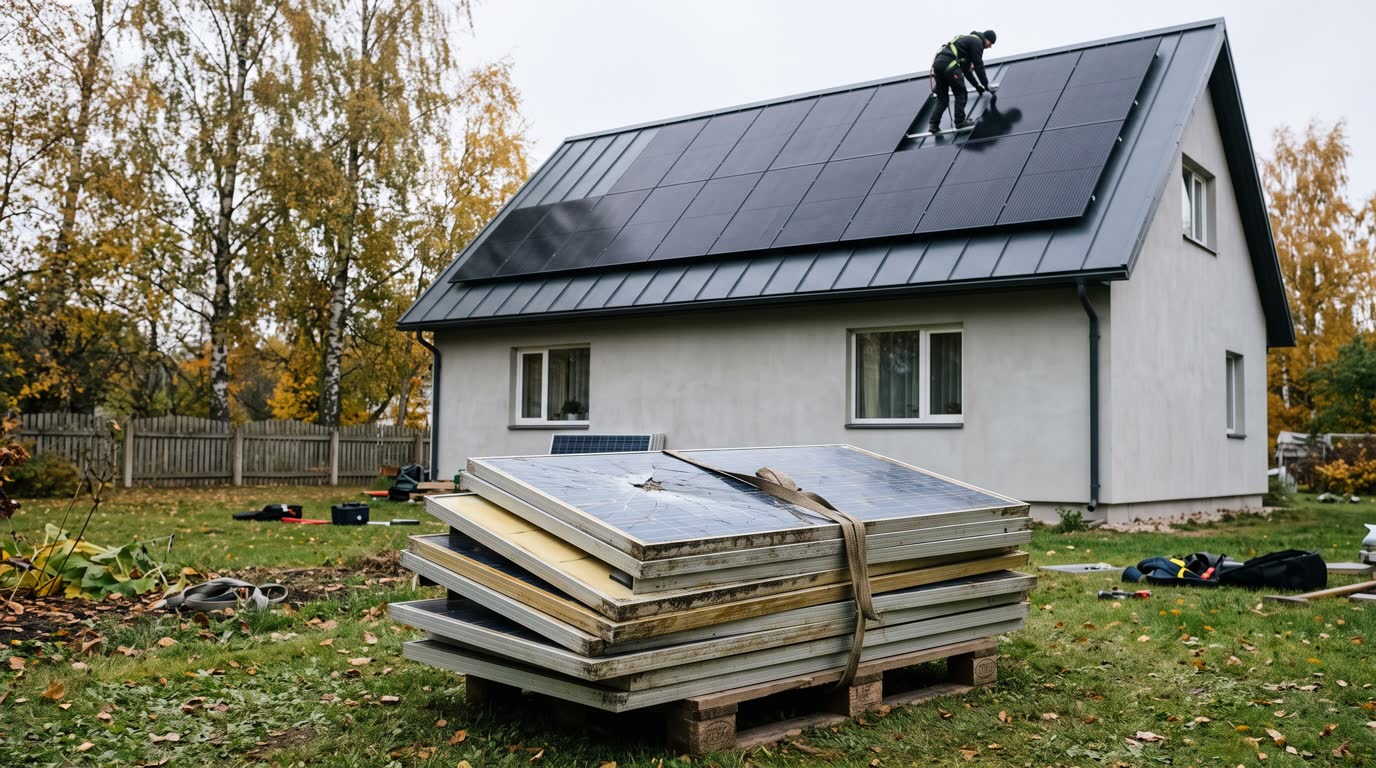
Because of massive production in China, the price of solar panels has fallen to an exceptionally low level, tehnika.postimees.ee writes. Unprecedentedly cheap solar power is bringing electricity to millions of people in both rich and developing countries, but at the same time it confronts traditional power grids with entirely new challenges. In Estonia, too, it is worth thinking before buying panels about what will happen to them at the end of their service life, because solar panels are electronic equipment subject to producer responsibility.
Cheap solar panels mean more waste in the future
Solar panels last 25 to 30 years on average, which means that a large share of the panels being installed now will only become waste around the 2050s. As installation volumes are growing quickly and panels have become cheap, the future amount of waste is growing at the same pace. The European Environment Agency estimates that Europe will generate 1.5 million tonnes of solar panel waste by 2030, and the International Renewable Energy Agency (IRENA) estimates that up to 80 million tonnes may accumulate worldwide by 2050.
In Estonia, grid-connected solar generating capacity exceeded 800 megawatts in 2023. According to the Register of Products of Concern, more than 4,000 tonnes of solar panels reached the Estonian market in 2022, but only about 2 tonnes were collected as waste. The first large quantities of old panels are therefore still to come, and the collection network has to be ready for them.
A solar panel is an electronic device
Solar panels are electrical and electronic equipment, and European Union Directive 2012/19/EU prohibits the landfilling of e-waste. An old panel must therefore be sent for recycling in the same way as a fridge or a washing machine. A typical silicon-based solar panel consists of about 80% glass, 8% aluminium, 10% polymers, 5% silicon, 1% copper and 0.1% silver. At present it is mainly the glass and aluminium that are recycled, but technologies are being developed in Europe to recover silicon, silver and copper as well.
For panel importers and sellers, the status of electronic equipment means producer responsibility. The quantities placed on the market must be registered in the Register of Products of Concern (PROTO), and the collection and recovery of the panels must be organised. The simplest way to meet these obligations is to join a producer responsibility organisation, which submits reports and organises collection on the company’s behalf. The same obligations also apply to the online shops through which cheap panels reach Estonia.
Where to take an old solar panel?
Household solar panels are accepted free of charge at waste stations, like other large electronic equipment. For larger quantities or the panels of an entire solar park, collection must be arranged in advance, and for this it is best to contact Eesti Elektroonikaromu. You can find the nearest collection point on the map. A cheap panel is a good investment only if its service life ends in recycling, not at the edge of a field or in a landfill.
Read more: Solar panels have become incredibly cheap, and now may be the best time to buy them, tehnika.postimees.ee (in Estonian) and the Eesti Elektroonikaromu article Solar panels: reuse and circular economy opportunities.
- Small electronics – 13 surprising items that must not go into mixed municipal waste

- Battery fires caused 2.66 billion euros of damage to the EU waste sector
- Every battery gets a QR code in 2027, but only large batteries get a battery passport
- Liisu Miller shows in a video where to take old chargers and cables
- Water-damaged devices: what to do after a flood?
- A household danger that can start fires and fits in the palm of your hand