

Energy storage producer responsibility concerns more and more companies, because alongside solar panels, a growing number of energy storage systems for homes and businesses are reaching the Estonian market. A growing market also means new importers, who may be surprised to learn that bringing equipment into Estonia from abroad comes with producer responsibility obligations. Companies that sell complete solutions and do not see themselves as importers of electronics or batteries should pay particular attention.
In this article:
What is energy storage producer responsibility?
Why does energy storage producer responsibility also concern energy solution providers?
Five questions an importer must check
Join a producer responsibility organisation
Reading time: 5 minutes.
What is energy storage producer responsibility?
The principle of producer responsibility is simple: whoever places a product on the market must also take responsibility for what happens to it at the end of its life. It is important to know that, for the purposes of producer responsibility, a producer is also whoever places a product on the market in Estonia for the first time. Energy storage systems contain both batteries and electronic equipment, and producer responsibility is particularly important for both, because they contain valuable materials. When properly collected and treated, both electronic equipment and batteries can be put back into use as materials, but if they end up in the wrong waste stream, they can cause environmental damage and a fire risk.
The aim of energy storage producer responsibility is to ensure that there is a working and funded system for collecting used batteries and treating them properly, and that its costs are not borne solely by the waste holder or by society. That is why the producer or importer becomes responsible as soon as a battery is placed on the market, not years later when it becomes waste. Since 1 January 2026, battery producers have also been obliged to join a producer responsibility organisation.
Why does energy storage producer responsibility also concern energy solution providers?
“Alongside solar panels, more and more different energy storage systems are coming onto the market, and we see new sellers and installers joining very actively. However, companies are often surprised that producer responsibility obligations also apply to them. A company may see itself as a builder of solar parks or a provider of energy solutions, but in legal terms it may at the same time also be a producer. If equipment is bought abroad and brought onto the Estonian market, it is necessary to check which producer responsibility obligations come with it,” said Kaur Kuurme, member of the management board of Eesti Elektroonikaromu.
According to Kuurme, what makes things more complicated with energy storage is that a single solution sold to a customer may consist of several different products. “If a company sells a customer, for example, solar panels, an inverter and a battery storage unit together with installation, the customer sees an energy solution package. From the producer responsibility point of view, however, you have to look at which devices and batteries in that solution are actually brought onto the Estonian market from outside Estonia and which requirements apply to them,” Kuurme explained.
Five questions an importer must check
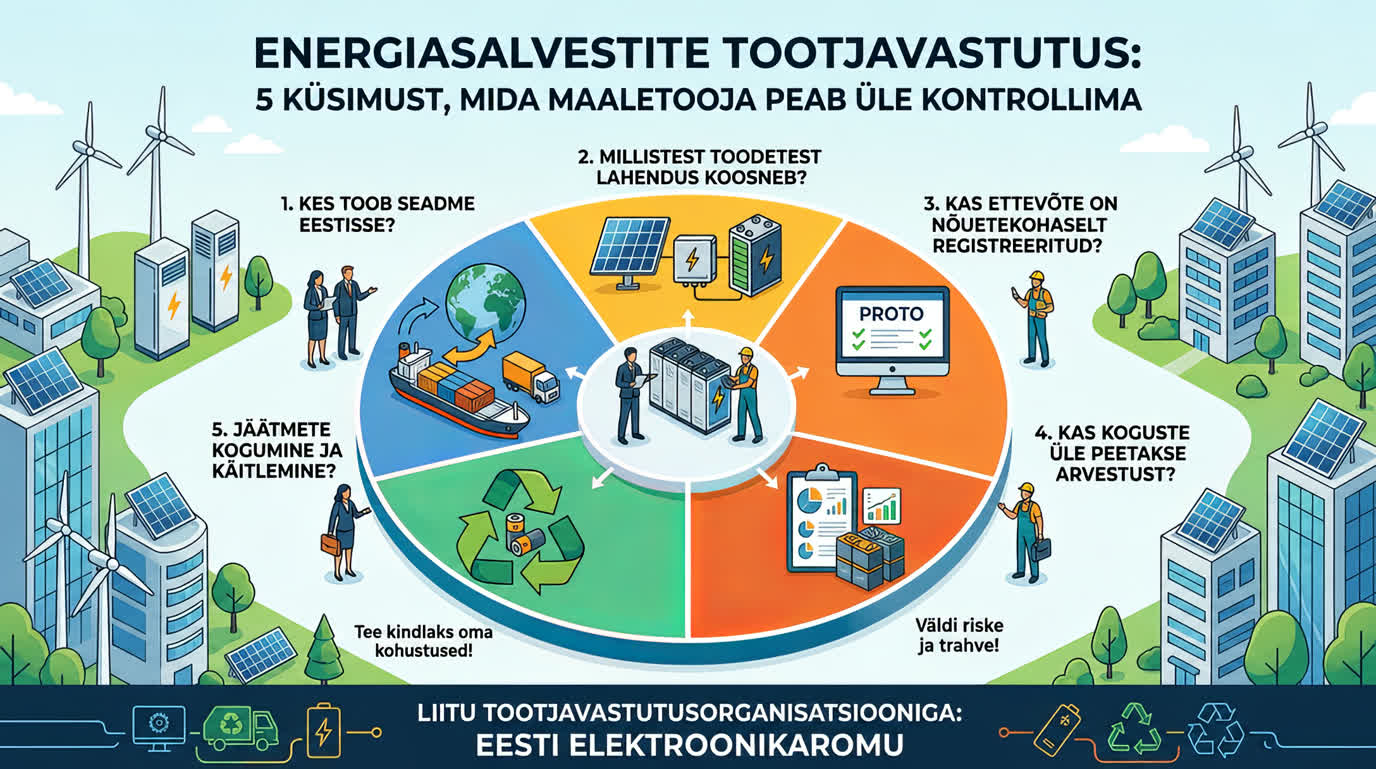
We recommend that sellers and installers of solar panels and energy storage solutions establish five important factors in order to be sure whether energy storage producer responsibility requires them to join a producer responsibility scheme.
1. Who brings the device into Estonia?
If a company buys a device abroad and places it on the Estonian market for the first time, it may be a producer for the purposes of energy storage producer responsibility. If the goods are bought from an Estonian company that has already placed them on the market here, it must be established whether producer responsibility has been arranged through that company.
2. Which products does the solution consist of?
A complete energy solution may include solar panels, batteries, inverters, control devices and other electronics. From the producer responsibility point of view, these are products of concern, which under the Waste Act are subject to producer responsibility obligations and an obligation to register the company in the Register of Products of Concern (PROTO).
3. Is the company properly registered?
Placing products of concern on the market comes with registration and reporting obligations in PROTO. Energy storage producer responsibility requires the company to check whether a PROTO registration for electronic equipment and for batteries exists, either for the company itself or for its supply partner.
4. Are records kept of the quantities placed on the market?
A company must know which products covered by producer responsibility it places on the Estonian market and in what quantities. For this, the necessary data must be available from the company’s purchase, warehouse or sales records.
5. How is the collection and treatment of future waste organised?
The producer does not have to build a collection and treatment system on its own. To meet the obligations of energy storage producer responsibility, an importer of household equipment and industrial equipment as well as of batteries must, under the Waste Act (in Estonian), join a producer responsibility organisation, which organises the collection and treatment of waste on behalf of producers and helps them meet the related obligations.
Join a producer responsibility organisation
The producer responsibility organisation Eesti Elektroonikaromu OÜ organises both a nationwide collection network and the further recycling of the collected equipment, and submits data to PROTO on behalf of its member companies. This means that a company then only needs to submit a report once a quarter, and Eesti Elektroonikaromu takes care of the rest.
“The most sensible thing is to go through these questions as soon as a company starts bringing new equipment into Estonia. Working out years later, after the fact, what was placed on the market and in what quantities, and which obligations should have been met, is much more complicated,” Kuurme added. “The Environmental Board monitors compliance with the law, and if it is breached, the fine can reach up to 400,000 euros under the law.”
If a company brings solar panels, energy storage systems or other electronic equipment into Estonia, it is worth reviewing energy storage producer responsibility before the first delivery arrives. Joining a producer responsibility organisation is easy, and if you have questions, the Eesti Elektroonikaromu team can help.
Join the most effective producer
responsibility organisation in Estonia.
We collect and recycle electronics, batteries and accumulators.
We organise e-waste reporting.
- Battery fires caused 2.66 billion euros of damage to the EU waste sector

- Every battery gets a QR code in 2027, but only large batteries get a battery passport
- Small electronics – 13 surprising items that must not go into mixed municipal waste
- Liisu Miller shows in a video where to take old chargers and cables
- Water-damaged devices: what to do after a flood?
- A household danger that can start fires and fits in the palm of your hand